AI Doesn't Pick the Best Content. It Picks the Most Authoritative Source. Here's the Difference.

If your SaaS brand isn’t seen as a safe source, AI may skip you even when your article is better. That’s the core point.
I’d sum it up like this:
- AI picks sources, not just pages
- Strong writing helps, but source reputation often decides the citation
- Page-one rankings no longer mean AI visibility
- Brand consistency, third-party mentions, expert signals, and topic depth matter
- You should track AI citations the same way you track search traffic
A few numbers make the shift hard to ignore:
- Organic top-10 overlap with AI Overview citations fell from 76% to 38%
- Organic click-through rates can drop 30% to 65% when AI Overviews appear
- 89% of AI-surfaced pages for high-intent queries come from domains with DR 85+
- Content with 15+ recognized entities per 1,000 words has a 4.8x better chance of being cited
Here’s the simple difference:
| Topic | Best Content | Most Authoritative Source |
|---|---|---|
| Focus | The page itself | The brand or author behind it |
| What AI checks | Clarity, structure, facts, extractable answers | Consistency, outside mentions, expertise, entity match |
| Main risk | Good page still gets ignored | More likely to be cited |
| Bottom line | Supplies the answer | Gives AI a reason to trust the answer |
What I took from the article is simple: winning in AI search is not just a writing job. It’s also a source-building job. If I want my content cited, I need to publish strong pages and make my company easier for AI systems to verify across the web.
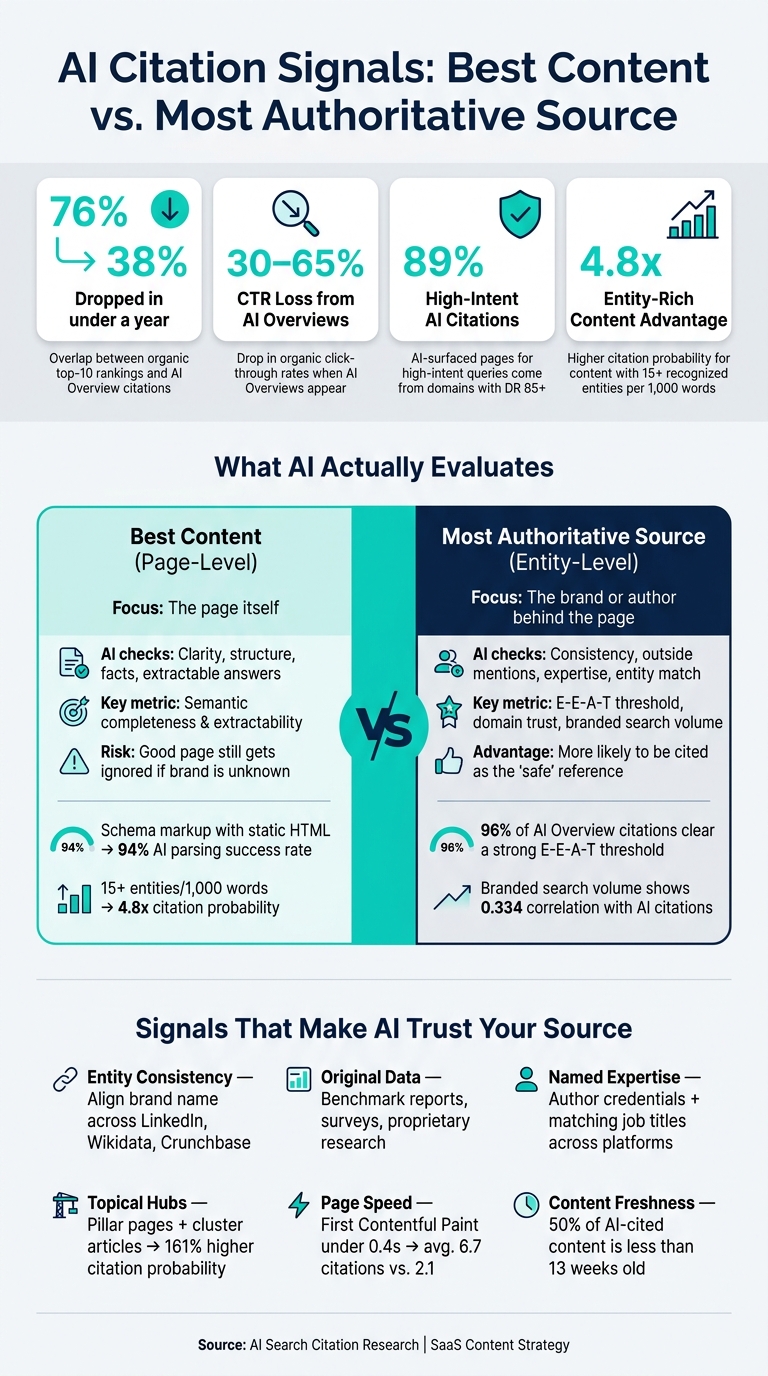
AI Citation Signals: Best Content vs. Most Authoritative Source
Build Topical Authority for AI Search - Complete Strategy Session
sbb-itb-9cd970b
The problem: well-written articles lose to better-known sources
AI systems tend to favor sources they can verify and repeat, not just the page with the best explanation. That’s why a strong niche post can lose to a more established source covering the same topic.
Why AI answers cite established entities instead of isolated posts
The main issue is simple: AI citation is a risk call, not a writing contest. As Atomic Design puts it:
"A generative engine has one failure state that matters more than any other: being confidently wrong... Every source it names is a source it has decided is safe to repeat." [1]
When a brand appears again and again across separate sources, AI has more reason to trust it. Brand identity plays a part here too. Pages with 15 or more recognized entities per 1,000 words have a 4.8x higher chance of being picked for an AI answer [3][10].
Example: a high-quality niche article vs. HubSpot, Gartner, or Salesforce
You can see the gap fast in a side-by-side case. Say a SaaS marketer publishes a detailed, data-backed guide on CRM adoption for mid-market teams. It includes original research, expert quotes, and clean formatting. Then a more established source publishes a shorter, broader piece on the same subject.
In an AI-generated answer, the established source is more likely to get cited. Not because it’s always better written, but because its authority is easier to verify.
Authority tends to cluster around brands with broad proof across the web. 89% of pages surfaced by AI for high-intent queries come from domains with an Ahrefs Domain Rating (DR) of 85 or higher [1]. At the same time, the overlap between organic top-10 rankings and AI Overview citations dropped from 76% to 38% in less than a year [1][10].
Here’s where the gap usually opens up:
| Signal | High-Quality Niche Article | Established Source (HubSpot/Gartner/Salesforce) |
|---|---|---|
| Content quality | High - original data, expert quotes | Moderate to high |
| Domain reputation | Lower and less established | Higher and more established |
| Third-party corroboration | Limited - few independent mentions | Extensive - visible across the broader web |
| Brand identity consistency | Weaker - less consistent web-wide identity | Stronger - consistent entity signals |
| Credibility filter | Often filtered out at the authority gate | More likely to clear the trust threshold |
| Likelihood of AI citation | Low, unless the page is highly structured | High, because the source is seen as safer to repeat |
Next, break down the signals AI uses to treat one source as safer than another.
Best content vs. most authoritative source: what the difference actually means
These two ideas sound close, but they do different jobs.
Best content is a page-level call. It’s about how useful, clear, and original one article is.
Most authoritative source is an entity-level call. It’s about how steady, verifiable, and backed-up the brand or author behind that article is across the web.
That matters because AI doesn’t judge the page alone. It looks at the source behind the page too. In practice, AI sorts sources by reliability across related topics. So even a strong article can lose out if the site or author behind it doesn’t show enough trust signals.
You can think of it like this: the page supplies the answer, but the source gives AI a reason to trust that answer.
That split shows up in two groups of signals: page-level and entity-level.
Page-level signals focus on the content itself. AI tends to favor pages with answer-first intros, clear headings, factual detail, and easy-to-pull answer blocks. There’s hard data behind that. Content with 15 or more recognized Knowledge Graph entities per 1,000 words has a 4.8x higher selection probability for AI citations [8][9]. Schema markup matters too. Static HTML with schema reaches a 94% AI parsing success rate, while JavaScript-rendered content without schema reaches only 23% [7].
Entity-level signals focus on the source. AI checks whether your brand name appears the same way across your website, LinkedIn, G2, Crunchbase, and Wikidata. It also looks for third-party mentions in trusted publications, industry forums, and podcasts. Branded search volume plays a role as well, showing a 0.334 correlation with AI citations [6][7]. Clear, named expertise helps here too. Anonymous bylines or generic author labels send a weaker signal.
This gap becomes obvious in citation behavior. 96% of AI Overview citations come from sources that clear a strong E-E-A-T threshold [8][9]. So yes, content quality helps a page get pulled into the answer. But source authority is often what makes that page cite-worthy.
Here’s the shorthand version:
| Feature | Best Content (Page-Level) | Authoritative Source (Entity-Level) |
|---|---|---|
| Primary strength | Useful, clear, original writing | Verifiable reputation and external validation |
| Detectable signals | Answer-first structure, clear headings, original data, schema markup | Entity consistency, branded search volume, third-party mentions, backlinks from trusted domains |
| AI citation likelihood | High risk of being ignored if the brand is unknown | Higher likelihood of being cited as the safe reference |
| What it does | Provides the text for the answer | Provides the validation for the answer |
| Key metric | Semantic completeness and extractability | E-E-A-T threshold, domain trust, branded search volume |
How to build content AI will trust and reference
If page quality is the words on the page, authority is the system behind those words. That distinction only helps if you build both into your content engine. So don’t just tune one blog post at a time. Build a source AI can spot, check, and cite.
Build topical authority with hubs, clusters, and internal links
AI tends to prefer focused coverage over random posts spread across a dozen subjects. A single pillar page for each core topic, backed by closely linked cluster articles, is much easier to trust and cite than a pile of thin pages that overlap.
Internal links do more than help readers move around. They also reinforce the pillar page as the main reference point and strengthen the authority signal across the topic. Pages that cover a topic in depth and answer related sub-queries have a 161% higher citation probability [2].
Freshness matters too. Half of all content cited in AI answers is less than 13 weeks old [7]. That means cornerstone pages need regular updates: new data, a visible dateModified, and a sharper intro that gets to the point fast.
Once that structure is set, the next step is proving who’s behind the source.
Add proof through experts, citations, backlinks, and original data
Structure gets you noticed. Proof helps you stay there.
Move past anonymous bylines. Named author credentials, matching job titles across your site and LinkedIn, and clear signs of company expertise all help AI figure out who is making a claim [5][6][7]. That kind of consistency matters. If your site says one thing and your public profiles say another, it muddies the waters.
Third-party mentions can help too, but not all mentions carry the same weight. Mentions that repeat a specific fact about your brand matter more than generic backlinks [5][6]. In plain English: a clear, repeated signal beats vague praise.
Original data also gives people a reason to cite you by name. That can include:
- Benchmark reports
- Survey findings
- Proprietary research
When other publications reference those assets, AI gets more proof that your brand is a reliable source [5][6][9].
Implementation table: authority tactic, AI signal, and best page type
| Authority Tactic | AI Signal Supported | Best Page Type |
|---|---|---|
| Source authority consolidation | Retrieval efficiency; reduces authority signal dilution | Pillar pages, topic hubs |
| Entity consistency | Knowledge Graph resolution | About Us, founder bios, Wikidata |
| Result documentation | Grounding and verifiability of claims | Case studies, product spec pages |
| FAQ schema markup | Structural legibility; direct Q&A mapping; 73% selection boost for AI Overview inclusion [9][7] | Solution pages, comparison pages |
| Original data and benchmarks | Citation ecosystem depth; retrieval weight | Research reports, benchmark studies |
With those signals in place, the next move is to audit them and watch whether AI starts citing your brand.
Apply and measure: a repeatable checklist for AI visibility
Once those source signals are in place, use this checklist to see if AI systems can actually find, trust, and cite your brand.
These are the signals that help move a page from “good enough” content to something AI treats like a source.
Checklist for content infrastructure, entity signals, and brand reputation
Use this checklist each month to turn authority signals into something you can track.
| Category | Action | AI Signal / Benefit |
|---|---|---|
| Infrastructure | Allow OAI-SearchBot in robots.txt and add llms.txt |
Keeps content accessible for real-time search |
| Infrastructure | Keep First Contentful Paint under 0.4 seconds | Pages under this threshold average 6.7 citations; those over 1.13 seconds drop to 2.1 [11] |
| Entity | Align Person and Organization schema across LinkedIn, Wikidata, and Crunchbase | Consistent public entity signals across platforms |
| Entity | Target 15+ recognized entities per 1,000 words | 4.8× higher selection probability [8] |
| Reputation | Publish consistent factual brand claims on third-party profiles and review sites | Third-party corroboration AI systems use to verify consensus |
| Content | Lead each section with a direct answer in the first 1–2 sentences | Improves how easily AI can lift a section for RAG systems |
| Content | Update pillar pages quarterly with a visible dateModified timestamp |
RAG systems favor content updated within the last 6–18 months [5] |
Allow OAI-SearchBot for search citations, and block GPTBot on its own if you want to stop training use.
How to track whether AI systems are starting to reference your brand
After the checklist is live, track share of AI answers, not just traffic.
The clearest sign that this work is paying off is simple: your brand starts showing up inside AI-generated answers, not just as a blue link sitting underneath them.
A good place to start is a manual share of AI answers audit. Build a fixed set of 30–50 high-intent buyer questions tied to your category, then run those same prompts each month across ChatGPT, Perplexity, and Google AI Overviews. Log whether your brand is cited, linked, or mentioned by name. That gives you a baseline, and it makes month-to-month movement much easier to spot [5][11].
On the analytics side, there’s now a cleaner way to spot part of this traffic. Since June 2025, ChatGPT has added utm_source=chatgpt.com to citation links, which makes it easier to break out AI referral traffic inside GA4 [11]. Filter for chatgpt.com and perplexity.ai as referrers. That matters because AI-referred visitors convert at 14.2%, compared with 2.8% from standard Google organic results [2]. Put differently, even a small number of citations can drive traffic that’s far more likely to turn into pipeline.
If you don’t want to do all of this by hand, tools like Profound, Peec AI, and Otterly.AI can track brand mentions and share of AI answers across multiple LLMs [4][5]. And don’t lump every platform together. Only 11% of domains appear in AI answers on both ChatGPT and Perplexity, so platform-by-platform tracking matters [11].
Conclusion: authority builds over time, and AI follows it
AI cites the source it can verify and trust. That changes what “good content” means for SaaS and AI marketers.
Writing quality still matters, but it’s not the main thing. What tends to move results is entity strength, expert credibility, citation depth, and steady topical coverage. And that work happens over months, not in one publish sprint. The teams that treat content like a source instead of a pile of posts are the ones AI systems keep coming back to.
FAQs
Why does AI trust authority over quality?
AI leans toward authority for one simple reason: it’s trying to manage risk.
When a generative AI system gives a direct answer, it doesn’t have much room to hedge. If it gets something wrong with confidence, that mistake can hurt how much people trust it. So it tends to play it safe.
That’s why citation works more like a trust decision than a writing contest. AI usually favors sources that are:
- Verifiable
- Consistent
- Easy to parse
- Widely recognized
In plain English, a clear source with support behind it will often beat content that’s polished and well written but doesn’t show where its claims came from.
Can a smaller brand still earn AI citations?
Yes. Smaller brands can earn AI citations by going deep on a topic and making their pages easy to parse, not just by leaning on raw domain authority.
To do that, they need to clear the E-E-A-T bar with clear author credentials, steady entity recognition, and structured data. Then they need to become the go-to source through original data, answer-first formatting, and independent mentions on third-party platforms.
How do I measure AI visibility?
Track AI visibility separately from organic rankings. Search performance just isn’t a solid stand-in for AI citation anymore.
A simple way to check where you stand is to run 20 representative queries where your brand should show up. Then calculate your actual citation rate based on those results.
You can also use specialized tools like Promptwatch to see which pages get cited, spot content gaps, and fine-tune pages for AI retrieval.
One thing matters here: citation patterns differ across ChatGPT, Perplexity, and Google AI Overviews. So if you lump them together, you’ll miss what’s going on. Measure each platform on its own.